quinta-feira, 25 de fevereiro de 2010

Amadeo Souza-Cardoso

"Menina dos Cravos" ( Carnations Girl ), 1913

" Procissão Corpus Christi" ( Corpus Christi ), 1913

" Barcos" ( Boats ), 1913

"A Cozinha da Casa de Manhufe" ( Manhufe's Kitchen), 1913


Amadeo Souza Cardoso was a painter from Amarante who introduced the modern art in Portugal. Although his work has some cubist influences it is mostly known by his futurist style. I like particularly the " Corpus Christi", its colours, geometric shapes and composition that seem chaotic at first sight, however has something more covered up that is perfectly defined after looking a few minutes.

The Impressionism


"The atelier boat", Claude Monet


Impressionism is one of the periods of Art History that I most appreciate. I like particularly the technique of representing a real scene or an object or even a person using the effect of reflected light and also the primary colours. Claude Monet is my favourite. His own sensations are reproduced using the contrast of shadow and light. It is such incredible that the movement of water, even of clouds or leaves is felt when we look at his paintings. I like his complicity with nature. The old boat was used as a floating workshop to be closer to inspiration.

quarta-feira, 24 de fevereiro de 2010

Art, Design & Architecture

Back for a new aim this time called “Art, Design & Architecture “.

For a start I would like to mention that the subject of this project is one of my favourites. Once in the past I studied Art & Design in secondary school so this will give me the pleasure to recall the knowledge I acquired from that great time; other will certainly be the result of an extensive research that I'll be treating on until the end of this project.

In addition I would like to say that more than learning about Art& Design I had the opportunity to enlarge the sensitiveness and openness to look at every kind of human art expression with other eyes. So I guess I got the curiosity of an artist!

When I first thought about what I would choose to represent each one of the items “Art, Design & Architecture “, I remembered of the good old times of researching in the Art Library of Calouste Gulbenkian Foundation in Lisbon city.
Although I do prefer contemporany art rather than others I will post here some of my favorite works from earlier centuries. First I will refer to a period of Art History – specifically, the Impressionism, then I will mention two portuguese painters with especial attention to Amadeo Souza-Cardoso. José Malhoa is not one of my favourites but I do like all the realism that can be found in several of his paintings.

sexta-feira, 5 de junho de 2009

My Museum

African Mask

I have it fixed on the wall of my bedroom. I bought this fantastic african mask in a handicraft market a few years ago. Its related to my great interest in people from different cultures. The African tribes and its religious ceremonies are one of the most interesting and mysterious subjects.


Pipe Incense Burner

I believe that burning incense can bring you positive energy or at least, it can make your surrounding more magical. I brought this burner from Aljezur, Algarve.

Photo Collection

I brought this photos from my old house in Lisbon when I was 17 years old. They belonged to the vanished family of the house owner where we were living. Some of those photos remained to 1903 and are signed by Souza & Paul from Real House of Portuguese India.

Pakistan Onyx Glasses


This beautiful onyx wine glasses were a gift from a pakistan friend.


Tin Bracelet


I made it myself at art & design school classes when I was 14 years old. We learnt how to work with tin and linoleum materials.

Stone from Marão

It means my connection with nature. A few years ago I did an expedition to Marão mines and I pick up this little souvenir to my special collection.

Sketchbook

This was my art & design sketchbook. We had a daily exercise that consisted in draw somekind of object in a different type of paper. I did it the whole year and the difficult thing was to find such different number of sheet of paper.


CD Player System

This was my first cd's player sound system. I used it in my car but everytime there was a hole or a drop of speed it stoped playing!


Blue Clogs


I used them when I was a little child. In fact I don't remember that and sometimes I keep looking and thinking: ' Did I really use this?'


Strong-box from the 19th century


I inherited it from a great old friend of my parents who lived with us in Lisbon city. He was a very special person. Sometimes at night we talked for hours and hours and though he was about eighty years old he was one of my confident friends. He had travelled a lot and had lived in several different countries. He had worked with Orson Wells and Greta Garbo. His stories were amazing.

sábado, 23 de maio de 2009

The Parliament Building

Why Westminster?
In the Middle Ages the site was strategically important as it was located on the banks of the River Thames. It was known in medieval times as Thorney Island.
In the 11th century, St Edward the Confessor, the penultimate Saxon monarch of England, built a royal palace at about the same time as he built an abbey, just one close to the other. As it was located in the part west of the city of London the area and also the palace started to call Westminster, a contraction of the words West and Minster ( Abbey ).
Why here?

The palace of Westminster where today are located the Houses of Parliament was for a long period of time the residence of the royal family.
Several english monarch lived here 'till Henry VIII moved out in 1512 following a fire that destroyed part of the building.
The english monarchy called Great Councils in order to met with archbishops, bishops, abbots, barons and earls, basically the pillars of the feudal system.
The Great Council evolved into the Parliament of England by the 13th century.
However the seat of parliament was not permanently based at Westminster.It was wherever the King was.
The King Edward I called the first Model Parliament on 13 November 1295. It has been called the Model Parliament because it was from this meeting that all future meetings were based upon. In 1341 it was not possible to accomodate the whole of Parliament inside the Palace.
The State Opening Ceremony was hold in the King's private apartment, the Painted Chamber. The Lords were meeting in the White Chamber for their discussions, but the Commons at this time didn't have a recognised home for their own. Sometimes they remained in the Painted Chamber or in the Chapter House, but in 1550 St Stephen's Chapel had become the first permanent home for the House of Commons.


Why the Neo-Gothic Style ?
'The Neo-Gothic style resembled the look from the mid-12th century to as late as the end of the 16th century. It had a strong "cathedralic" touch and an evident religious association. By the 1830's it was welcomed as a delightful alternative to the Neo-Classic of the preceding decades. '
On 16 October 1834 the palace was almost destroyed by a devastating fire which started by the overheating of a stove in the House of Lords.
By this time, the English Parliament progressively limited the power of the English monarchy after the English Civil War and the trial and execution of Charles I.
The House of Commons had grow up its legislative power and number of members, meanwhile the House of Lords was the part of the High Court of Parliament involved in judicial work.
A House of Commons Commitee was set up in 1835 and it was decided that a public competition would determinate the designer of the redeveloping of the new palace.
It was also decided that the new Palace of Westminster would be built in the Gothic or Elizabethan style. The Gothic Revival was associated with monarchism and conservatism and it started grow rapidly in England by the 18th century.This explain its choise to the rebuilt of the still officially royal palace.
The Neoclassical style was associated with republicanism and liberalism and its evidence is present in the White House of the United States of America.

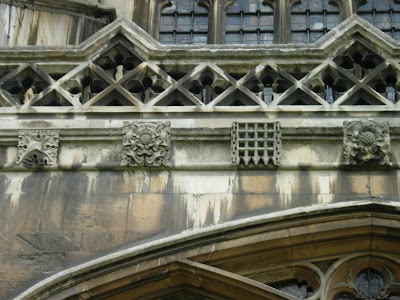


Why the Portcullis
and the 'Fleurs-de-Lys'?

' The Portcullis probably came to be associated with the Palace of Westminster through its use, along with Tudor roses, fleurs-de-lys and pornegranates, as decoration in the rebuilding of the Palace after the fire of 1512.'
from the House of Commons Information Office Factsheet.

The Houses of Parliament are represented by an emblem which is known as the Crowned Portcullis.
This symbol is primarily used to authenticate communications from Members. As it have different colours for each of one of the houses it become easier to identify the origin of the documents.
The Portcullis symbol and the 'Fleur-de-Lys' were used by Charles Barry, the architect responsable for the rebuilt of the Palace of Westminster. It was employed by the first and second sovereigns of the Tudor dinasty as its badge and probably used everywhere in the Palace as it was Henry's family residence.
It was under the Tudors that the palace became the regular meeting place of Parliament. So this can be associated to the Barry's carving choice.


Why the coulour green in the House of Commons decoration?

The colour green represented the bounty of nature and fertility during medieval period. It was the colour of the pasture and the greenwood. It was the colour of the countryman, the 'common' man.


Why the colour red in the House of Lords decoration?
The colour red is identified as a royal colour from its use by kings. It was used in the rooms where the king met his court and nobles.

sábado, 18 de abril de 2009

The Succession of Henry VIII

Edward VI was only nine when he succeeded his father as king of England and supreme head of the English church.

Queen Mary, who was catholic like her mother, married Philip II of Spain, a Catholic, and the English were in violente disturbance.
A few years later Queen Mary died, probably of ovarian cancer, and Elizabeth succeeded her on the throne.The Virgin Queen, Gloriana, under whose reign the English Renaissance came to full bloom, and the arts and literature, especially poetry and theatre, flourished. It was in Queen Elizabeth's reign, the Elizabethan era, that English literature gained its shining stars: Christopher Marlowe and William Shakespeare. Early Modern literature would likely never have reached the heights it did, had it not been for Queen Elizabeth.

sexta-feira, 17 de abril de 2009

The Children Of Henry VIII

Queen Mary I ( daughter of Catharine of Aragon )
also known as "Bloody Mary" for the number of Protestant executions in her reign.

Queen Elizabeth I ( daughter of Anne Boleyn )
also known as "The Virgin Queen" the strongest and most successful monarch in the history of Britain.


King Edward VI ( son of Jane Seymour ) also known as "The Boy King" did not live very long.

Information Sources: Encyclopedia Britannica, 11th Ed., Vol XIII.
Cambridge: Cambridge University Press, 1910. 289.

The Six Wifes of Henry VIII

Queen Catherine of Aragon ( Divorced )
Henry VIII's first wife and Henry's brother Arthur wife before his death. She was a very religious woman.

Queen Anne Boleyn

While married to Catharine, the King fell in love with Anne to the point of obsession, which resulted in his desire to obtain a divorce. She was accused of adultery by her enemies at court and was beheaded.

Queen Jane Seymour

The third wife of Henry VIII. She succeeded in giving birth to an heir to the crown — Prince Edward. She died a few days after childbirth from an infection.

Queen Anne of Cleves

Henry VIII's fourth wife.The King was not attracted to her and the marriage quickly resulted in divorce. Anne stayed in England, however, and remained in good relations with the King and all three of his children, as well as with his future queens.


Queen Catherine Howard
An attractive young lady, she had been pushed into the marriage by her own ambition, as well as the pressure of her powerful family.She started fooling around with young courtiers and was beheaded.

Queen Katherine Parr ( Survived )

King Henry VIII's last wife. A well-educated lady and a excellent writer with a keen intelligence and solid moral fiber. She outlast the intrigues of court, the bad temper of the King, and the general rigors of court life. She was a sweet-tempered, kind person and the children of King Henry VIII loved her.

Information Sources: Encyclopedia Britannica, 11th Ed., Vol XIII.
Cambridge: Cambridge University Press, 1910. 289.

quinta-feira, 9 de abril de 2009

The King Henry VIII of England ( 1509-1547 )

Family of Henry VIII 1545 ( Elisabeth on the right )
Unknown artist

Family of Henry VIII, an Allegory of the Tudor Succession 1572
National Museum and Gallery, London
Author: Lucas de Heere

By the beginning of the 16th century there was a current that defended that Roman Church should be reformed. This first happened in England with the rejection of the Pope Clement VII in order to stop the corruption that were frequently succeeding. Meanwhile in Germany a man called Martin Luther was founding a new kind of Christianity based in his interpretation of Bible.
The King Henry VIII (1509-1547) was the first English monarch to be a learner of the renaissance ideas and that was his regent lighting. He became a highly skilled scholar, linguist, musician and athlete. Although he was dissatisfied with the union with Catherine of Aragon ( his brother's widow ) it was completed in the first few months of his reign.
All of his sons had been dying in infancy so it was fairly certain that Henry VIII could have no male heir to the throne while Catherine remained his wife. There was Mary, but no queen regnant had yet ruled in England; he wanted his marriage annulled. All these considerations were intensified by Henry VIII's passion for Anne Boleyn, though she certainly was not the sole or the main cause of the divorce. That the succession was the main point is proved by the fact that Henry's efforts were all directed to securing a wife. As the Catholic Church refuse it, Henry assumed his supremacy over religious questions. He got divorced and implanted the English Church, the Protestantism.

Information Sources: Universal Modern Encyclopedia - Lexicoteca;
Encyclopedia Britannica, 11th Ed.,
Vol XIII.Cambridge: Cambridge University Press, 1910. 289.

sábado, 21 de março de 2009

What I am reading


«The Outcast is about a boy called Lewis - his childhood and adolescence – as he grows up in the stultifying world of the home counties in the late forties and fifties. It is an everyday tale of drunkenness, violence and a fair amount of sex, set amongst the well-brought-up professional classes. It is also a love story.»


sábado, 7 de março de 2009

How to write an Essay


Talking about the structure of an essay the title must be precise about what you intend to argue and the subtitle must give the framing of your position.

The development of an argument must start by defining an aim explaining what you intend to defend and how you will do it.

The ‘body’ of an argument must be coherent and concise using intellectual tasks as analogy and examples or making reference to theory and also using the rhetorical question.

The reader should be in touch with your understanding of the subject and also with your position.

The conclusion of an essay should corporate the summary of the main ideas and leaving in an intelligent way is giving voice to a challenge.

quinta-feira, 5 de março de 2009

Movement


Photos by Paula Ferreira
Covent Garden, London February 2009