sábado, 17 de abril de 2010

Henry Moore Sculptures


How did he create objects as if they could only have been the result of natural processes over millions of years?

His work is amazing. Effectively, Henry Moore’s sculptures seem to be created by Mother Nature. Its relation with surrounding space is incredibly perfect and harmonious, and its shapes are extremely beautiful.

William Blake, the " Glorious Luminary"

" The Song of Los"

" Ancient of days"
William Blake‘s work is extraordinary. Each one of his paintings is profoundly rich in meaning. Sometimes considered mad, he was very singular and expressive. His work shocked some conventional ideas in the 18th century. Somehow he can be compared with Banksy and his transgression.

quinta-feira, 15 de abril de 2010

Sir Eduardo Paolozzi


"Faraday"
University of Birmingham

" Head of a Dongon Mask"
( modelled plaster )

" Vulcan"
Central Square - Newcastle

I would like to make reference to Sir Eduardo Paolozzi, one of the members that founded the movement of the Independent Group in Britain. Despite starting his career working with collages in the mid-1950s influenced by American mass media and populist art, there was a great evolution in his work. He had become a wider artist, particularly in sculpture, creating his own view about things. He highlights future, science, research, knowledge and change. “Faraday” has over five metres high and was a gift to the University to mark its Centenary.

Information Source:http://www.whitfieldfineart.com/

terça-feira, 9 de março de 2010

One & Other Project


Art is somehow the way you express your own feelings, the way you get in touch with the others and especially with yourself. That moment is precisely the special moment you are making art, the moment you are dealing profoundly with yourself, the moment of reflexion, and the way you feel you can express it to get it known by the others or not . That is why everyone can somehow make a moment of art in their own life. You just have to explore your creativeness and keep in touch with yourself and what you are feeling about and then you find it… art.

And that’s why Antony Gormley is my favourite. I like the way he uses the human being form to express his own fears, doubts, thoughts, visions, his relations with the others, and particularly with himself and his identity. This is also what I feel about the project “One & Other”. I believe Antony Gormley actually wanted to give an opportunity to other people to express themselves, to let their feelings flourish and the result was simply unforgettable.

I do believe the purest way of making art is that in which the artist creates the simplest forms, and things are deeply profound and spontaneous.

Comment posted on:

sábado, 6 de março de 2010

Antony Gormley Sculptures


What I most like in Antony Gormley sculptures is that he works essentially with the human being form, its positions and relations with others and spaces. He is very simple but at the same time very objective. There is a message in each one of his works that surely has a strong meaning or at least I feel it that way. I really like a lot this one called "Witness". The man sitting, his head on the flexed knees and both arms crossed. The position of reflection. Is he the only witness of his reflection?

Angel of the North


I really really love this work! Antony Gormley is absolutely fantastic! I think is awesome such a simple structure can produce a magnificent illusion in surrounding space. The straight lines can effectively create the idea of someone's presence. I can even imagine its strength.. . One day I will certainly visit Newcastle to see and feel this Angel of Iron.

segunda-feira, 1 de março de 2010

José Malhoa

" Os Bêbados " ( The Drunks ),1907

" O Fado ", 1910
José Malhoa was a portuguese naturalist painter from 19th century. Details are the main point of his work like both paintings in which scenes are so extraordinarily real. I would like to mention the tie's detail in the man who is playing guitar and the woman who is loosing her shoe in " O Fado".

quinta-feira, 25 de fevereiro de 2010

Amadeo Souza-Cardoso

"Menina dos Cravos" ( Carnations Girl ), 1913

" Procissão Corpus Christi" ( Corpus Christi ), 1913

" Barcos" ( Boats ), 1913

"A Cozinha da Casa de Manhufe" ( Manhufe's Kitchen), 1913


Amadeo Souza Cardoso was a painter from Amarante who introduced the modern art in Portugal. Although his work has some cubist influences it is mostly known by his futurist style. I like particularly the " Corpus Christi", its colours, geometric shapes and composition that seem chaotic at first sight, however has something more covered up that is perfectly defined after looking a few minutes.

The Impressionism


"The atelier boat", Claude Monet


Impressionism is one of the periods of Art History that I most appreciate. I like particularly the technique of representing a real scene or an object or even a person using the effect of reflected light and also the primary colours. Claude Monet is my favourite. His own sensations are reproduced using the contrast of shadow and light. It is such incredible that the movement of water, even of clouds or leaves is felt when we look at his paintings. I like his complicity with nature. The old boat was used as a floating workshop to be closer to inspiration.

quarta-feira, 24 de fevereiro de 2010

Art, Design & Architecture

Back for a new aim this time called “Art, Design & Architecture “.

For a start I would like to mention that the subject of this project is one of my favourites. Once in the past I studied Art & Design in secondary school so this will give me the pleasure to recall the knowledge I acquired from that great time; other will certainly be the result of an extensive research that I'll be treating on until the end of this project.

In addition I would like to say that more than learning about Art& Design I had the opportunity to enlarge the sensitiveness and openness to look at every kind of human art expression with other eyes. So I guess I got the curiosity of an artist!

When I first thought about what I would choose to represent each one of the items “Art, Design & Architecture “, I remembered of the good old times of researching in the Art Library of Calouste Gulbenkian Foundation in Lisbon city.
Although I do prefer contemporany art rather than others I will post here some of my favorite works from earlier centuries. First I will refer to a period of Art History – specifically, the Impressionism, then I will mention two portuguese painters with especial attention to Amadeo Souza-Cardoso. José Malhoa is not one of my favourites but I do like all the realism that can be found in several of his paintings.

sexta-feira, 5 de junho de 2009

My Museum

African Mask

I have it fixed on the wall of my bedroom. I bought this fantastic african mask in a handicraft market a few years ago. Its related to my great interest in people from different cultures. The African tribes and its religious ceremonies are one of the most interesting and mysterious subjects.


Pipe Incense Burner

I believe that burning incense can bring you positive energy or at least, it can make your surrounding more magical. I brought this burner from Aljezur, Algarve.

Photo Collection

I brought this photos from my old house in Lisbon when I was 17 years old. They belonged to the vanished family of the house owner where we were living. Some of those photos remained to 1903 and are signed by Souza & Paul from Real House of Portuguese India.

Pakistan Onyx Glasses


This beautiful onyx wine glasses were a gift from a pakistan friend.


Tin Bracelet


I made it myself at art & design school classes when I was 14 years old. We learnt how to work with tin and linoleum materials.

Stone from Marão

It means my connection with nature. A few years ago I did an expedition to Marão mines and I pick up this little souvenir to my special collection.

Sketchbook

This was my art & design sketchbook. We had a daily exercise that consisted in draw somekind of object in a different type of paper. I did it the whole year and the difficult thing was to find such different number of sheet of paper.


CD Player System

This was my first cd's player sound system. I used it in my car but everytime there was a hole or a drop of speed it stoped playing!


Blue Clogs


I used them when I was a little child. In fact I don't remember that and sometimes I keep looking and thinking: ' Did I really use this?'


Strong-box from the 19th century


I inherited it from a great old friend of my parents who lived with us in Lisbon city. He was a very special person. Sometimes at night we talked for hours and hours and though he was about eighty years old he was one of my confident friends. He had travelled a lot and had lived in several different countries. He had worked with Orson Wells and Greta Garbo. His stories were amazing.

sábado, 23 de maio de 2009

The Parliament Building

Why Westminster?
In the Middle Ages the site was strategically important as it was located on the banks of the River Thames. It was known in medieval times as Thorney Island.
In the 11th century, St Edward the Confessor, the penultimate Saxon monarch of England, built a royal palace at about the same time as he built an abbey, just one close to the other. As it was located in the part west of the city of London the area and also the palace started to call Westminster, a contraction of the words West and Minster ( Abbey ).
Why here?

The palace of Westminster where today are located the Houses of Parliament was for a long period of time the residence of the royal family.
Several english monarch lived here 'till Henry VIII moved out in 1512 following a fire that destroyed part of the building.
The english monarchy called Great Councils in order to met with archbishops, bishops, abbots, barons and earls, basically the pillars of the feudal system.
The Great Council evolved into the Parliament of England by the 13th century.
However the seat of parliament was not permanently based at Westminster.It was wherever the King was.
The King Edward I called the first Model Parliament on 13 November 1295. It has been called the Model Parliament because it was from this meeting that all future meetings were based upon. In 1341 it was not possible to accomodate the whole of Parliament inside the Palace.
The State Opening Ceremony was hold in the King's private apartment, the Painted Chamber. The Lords were meeting in the White Chamber for their discussions, but the Commons at this time didn't have a recognised home for their own. Sometimes they remained in the Painted Chamber or in the Chapter House, but in 1550 St Stephen's Chapel had become the first permanent home for the House of Commons.


Why the Neo-Gothic Style ?
'The Neo-Gothic style resembled the look from the mid-12th century to as late as the end of the 16th century. It had a strong "cathedralic" touch and an evident religious association. By the 1830's it was welcomed as a delightful alternative to the Neo-Classic of the preceding decades. '
On 16 October 1834 the palace was almost destroyed by a devastating fire which started by the overheating of a stove in the House of Lords.
By this time, the English Parliament progressively limited the power of the English monarchy after the English Civil War and the trial and execution of Charles I.
The House of Commons had grow up its legislative power and number of members, meanwhile the House of Lords was the part of the High Court of Parliament involved in judicial work.
A House of Commons Commitee was set up in 1835 and it was decided that a public competition would determinate the designer of the redeveloping of the new palace.
It was also decided that the new Palace of Westminster would be built in the Gothic or Elizabethan style. The Gothic Revival was associated with monarchism and conservatism and it started grow rapidly in England by the 18th century.This explain its choise to the rebuilt of the still officially royal palace.
The Neoclassical style was associated with republicanism and liberalism and its evidence is present in the White House of the United States of America.

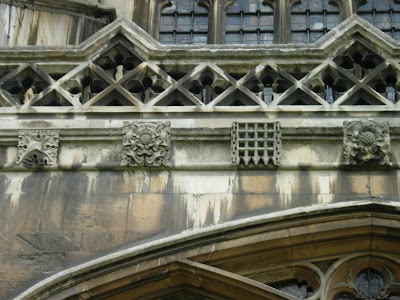


Why the Portcullis
and the 'Fleurs-de-Lys'?

' The Portcullis probably came to be associated with the Palace of Westminster through its use, along with Tudor roses, fleurs-de-lys and pornegranates, as decoration in the rebuilding of the Palace after the fire of 1512.'
from the House of Commons Information Office Factsheet.

The Houses of Parliament are represented by an emblem which is known as the Crowned Portcullis.
This symbol is primarily used to authenticate communications from Members. As it have different colours for each of one of the houses it become easier to identify the origin of the documents.
The Portcullis symbol and the 'Fleur-de-Lys' were used by Charles Barry, the architect responsable for the rebuilt of the Palace of Westminster. It was employed by the first and second sovereigns of the Tudor dinasty as its badge and probably used everywhere in the Palace as it was Henry's family residence.
It was under the Tudors that the palace became the regular meeting place of Parliament. So this can be associated to the Barry's carving choice.


Why the coulour green in the House of Commons decoration?

The colour green represented the bounty of nature and fertility during medieval period. It was the colour of the pasture and the greenwood. It was the colour of the countryman, the 'common' man.


Why the colour red in the House of Lords decoration?
The colour red is identified as a royal colour from its use by kings. It was used in the rooms where the king met his court and nobles.