
In the Middle Ages the site was strategically important as it was located on the banks of the River Thames. It was known in medieval times as Thorney Island.
In the 11th century, St Edward the Confessor, the penultimate Saxon monarch of England, built a royal palace at about the same time as he built an abbey, just one close to the other. As it was located in the part west of the city of London the area and also the palace started to call Westminster, a contraction of the words West and Minster ( Abbey ).
Why here?
The palace of Westminster where today are located the Houses of Parliament was for a long period of time the residence of the royal family.
Several english monarch lived here 'till Henry VIII moved out in 1512 following a fire that destroyed part of the building.
The english monarchy called Great Councils in order to met with archbishops, bishops, abbots, barons and earls, basically the pillars of the feudal system.
The Great Council evolved into the Parliament of England by the 13th century.
However the seat of parliament was not permanently based at Westminster.It was wherever the King was.
The King Edward I called the first Model Parliament on 13 November 1295. It has been called the Model Parliament because it was from this meeting that all future meetings were based upon. In 1341 it was not possible to accomodate the whole of Parliament inside the Palace.
The State Opening Ceremony was hold in the King's private apartment, the Painted Chamber. The Lords were meeting in the White Chamber for their discussions, but the Commons at this time didn't have a recognised home for their own. Sometimes they remained in the Painted Chamber or in the Chapter House, but in 1550 St Stephen's Chapel had become the first permanent home for the House of Commons.


 Why the Neo-Gothic Style ?
 'The Neo-Gothic style resembled the look from the mid-12th century to as late as the end of the 16th century. It had a strong "cathedralic" touch and an evident religious association. By the 1830's it was welcomed as a delightful alternative to the Neo-Classic of the preceding decades. '
On 16 October 1834 the palace was almost destroyed by a devastating fire which started by the overheating of a stove in the House of Lords.
By this time, the English Parliament progressively limited the power of the English monarchy after the English Civil War and the trial and execution of Charles I.
The House of Commons had grow up its legislative power and number of members, meanwhile the House of Lords was the part of the High Court of Parliament involved in judicial work.
A House of Commons Commitee was set up in 1835 and it was decided that a public competition would determinate the designer of the redeveloping of the new palace.
It was also decided that the new Palace of Westminster would be built in the Gothic or Elizabethan style. The Gothic Revival was associated with monarchism and conservatism and it started grow rapidly in England by the 18th century.This explain its choise to the rebuilt of the still officially royal palace.
The Neoclassical style was associated with republicanism and liberalism and its evidence is present in the White House of the United States of America.

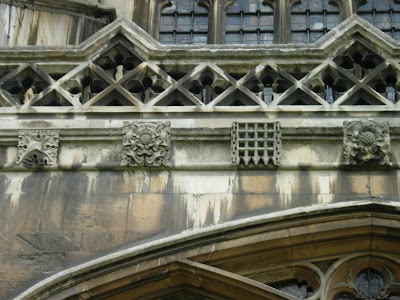 Why the Portcullis
' The Portcullis probably came to be associated with the Palace of Westminster through its use, along with Tudor roses, fleurs-de-lys and pornegranates, as decoration in the rebuilding of the Palace after the fire of 1512.'
from the House of Commons Information Office Factsheet.
The Houses of Parliament are represented by an emblem which is known as the Crowned Portcullis.
This symbol is primarily used to authenticate communications from Members. As it have different colours for each of one of the houses it become easier to identify the origin of the documents.
The Portcullis symbol and the 'Fleur-de-Lys' were used by Charles Barry, the architect responsable for the rebuilt of the Palace of Westminster. It was employed by the first and second sovereigns of the Tudor dinasty as its badge and probably used everywhere in the Palace as it was Henry's family residence.
It was under the Tudors that the palace became the regular meeting place of Parliament. So this can be associated to the Barry's carving choice.
 Why the coulour green in the House of Commons decoration?
 The colour green represented the bounty of nature and fertility during medieval period. It was the colour of the pasture and the greenwood. It was the colour of the countryman, the 'common' man.

Why the colour red in the House of Lords decoration? The colour red is identified as a royal colour from its use by kings. It was used in the rooms where the king met his court and nobles.


 I made it myself at art & design school classes when I was 14 years old. We learnt how to work with


